Showing posts with label gardening. Show all posts

Friday, May 11, 2012

*april showers brings may flowers

These are a few of the potatoes we planted a few months ago.  We have had an abundance of rain this past week, so with this in mind I dug some of the potatoes to see if they were mature enough to dig.  I certainly did not want them to start to rot in the overly moist soil.  Turns out... they were ready!  I planted the potatoes (100lbs) over a course of a months, so we have some that are still producing.  I have decided that I like growing white potatoes better, because of the larger production per plant.  The white potatoes were also much larger then the red ones as well.
This is one of the many beautiful sun flower's that popped up in our gardens. This one had  about 7 blooms on the one stalk.  It was gorgeous.  Here are a few more that I have captured as well...


FIGS!  I planted this fig tree last year! Imagine my delight when I counted 18 little figs this year!
Lady bug, Lady bug thanks for visiting our gardens.
Once the beautiful golden colors have faded away, another beauty lies beneath. I really think the sunflower is beautiful with the contrast of the green around the edge of the flower with the grey seed heads. 


I have been quite busy. On some days I feel like a one legged man in a but kicking contest (one of my best friends sayings.. when I say it I feel close to her), anyway spring to late fall is a busy time around these parts. It doesn't matter if my thyroid is producing as it should (energy level up or down), or if I have a cold or any other aliment - plants still produce, grass and weeds grow exponentially.   As I said earlier, we dug about 1/4 of our potatoes, our first squash were picked this week, we continue to harvest asparagus daily (YUM) as well as snow peas. 

Happy Gardening!

Saturday, April 7, 2012

*crowns of asparagus

Asparagus is one of those veggies that we didn't eat a lot of while growing up in the South during my childhood years. I however, love asparagus and have always wanted to grow it in our garden. Last year while shopping at Lowes Garden Center I found some asparagus crowns sitting there waiting on me! The first year of having them in our garden we didn't harvest to many spears but after a year of wintering over, we have harvested tons!! I am over the top thrilled. I want to encourage you, if you have thought about growing asparagus... DO IT! They are really one of the easiest plants to care for and harvest. Every day I have to snap off some delicious asparagus stalks to add to a salad, or steam for a side dish with our dinner.


The asparagus plants will grow and produce for about 8 years and then you have to replant your asparagus bed. Such a great investment. I paid under $7 for 6 or 8 asparagus crowns last spring and they have already paid for themselves several times over. Just think of the investment return I still have to come over the next 5 to 7 years.

Friday, April 6, 2012

*one potato, two potato, three...

Gardening is many things to many people. Whether it is done as a hobby, a stress reducer or provision for your family, gardening has many merits. For me it serves as all of the above. Gardening is a joy that I learned to love at my mother and fathers sides. They were pretty traditional in their gardening each year and I had great opportunity to learn their tricks and tips along the way.

One of the potato patches are shown here in the photo, closest to the bottom part of the image.


This spring we have many beautiful lush green vegetable plants growing in our gardens. The weather has allowed for early planting and we did jump on that opportunity.  My dh and I purchased 50 pounds of seed potatoes in early March.  Today those potato plants are an admirable beauty - in our eyes!   Momma and I stopped in at the Farm Center last week to pick up some okra seeds and found that they still had potato seeds in the store.  I inquired as to the price and was told they were giving them away at this point. Um... did you say FREE? Oh yeh, I am all about that. I will take two bags please. (total of 50 more pounds)  Momma and I worked last week to get half of those planted and the other half will go in this weekend.

I plant our potatoes in 4 inch deep trenches which allows me to go back and add mulched hay or dirt as they mature.  This continues as they grow their foliage until I have the rich soil and mulch piled up around the base of each potato plant. We should be able to start harvest some of the delicious new potatoes from the first ones planted sometime in May.  Normally I will let each potato plant finish out with the foliage dieing out before we dig them.   If possible and the weather is permitting, meaning it is dry I will even leave the in the ground several weeks after the tops have completely died off.  We do not have a root cellar, so leaving them in the ground as long as I can prolongs their shelf life a bit more.

Saturday, February 11, 2012

*winters triumphant return?

We have only had a few below freezing temps this winter, which one might think is normal for Florida. Not so much on the Gulf Coast, in fact the area we are located at is considered the coldest spot of Florida. When my dear husband found this out, he laughed. He does not like cold weather and was thrilled when we left NC in April's cold temps last year.  It seemed to have been a record cold winter for many states last year, this year is just the opposite - much milder. This, my dear is the kind of weather my dear husband loves! He is always saying, always summer, that is the theme of his Florida license plate, "Endless Summer". Smh


Tonight we are to have 24 degrees, um... that is cold.  This means our baby chicks will have to come back in doors along with their heat lamp in order to keep the temps warm enough for them.  It also means that some of our flowers, plants, and bushes that are sprouting or blooming may get set back with a freeze. There are a few preparations and precautionary measures we can take in order to protect our plants. Just this past week I transplanted over one hundred strawberry plants.


We started with 16 strawberry plants last spring.  When growing strawberries you can choose to do one of two things when your strawberry plants put out runners.  If you trim them your plant will produce more hearty fruit harvest, but if you let them grown you can increase the number of plants in your strawberry patch next year for zero dollars!  We now have over one hundred and fifty strawberry plants in our "strawberry patch".  We chose to let the runners grow after last years small harvest and put a bit of soil over the runner as it got rooted nicely, then we clipped it from the main plant.  This year, I transplanted all of the MANY runners that are now beautiful strawberry plants.


Today we spent time covering strawberry plants with hay.   Our neighbor told us we should wet the plants. Water the plants, wet them?  Um, did you hear that it was going to be below freezing tonight and tomorrow ? Interesting, because my best friend and I were talking just yesterday about preparations and she said she had read where farmers water their plants before a freeze.  We both commented on how we didn't understand how this would help.  After reading this, I have a better understanding of this method.


Hopefully the goats, chickens, baby chicks, rabbits, tender new growth of plants, and pipes are all safe and sound from winters' triumphant return! 


linked to The Country Garden Showcase
Barn Hop #49

Thursday, February 9, 2012

*gardening today for tomorrow

A few days ago I posted on gardening and planting potatoes from your cupboards. I had several to comment on my blog and private message me regarding this idea. I wanted to give a bit more attention to the potato seed planting today.

I thought I would read just a bit before writing this morning so I could bring you accurate information outside of my own experiences. You see, each year we buy "seed potatoes" from our local farm store. Many nursery's carry them, or seed and feed stores will carry them by the pound.  I do utilize any potatoes in the pantry that have started sprouting in the garden as well.


I have know for years that the potatoes from the grocers shelves have been treated with a chemical that inhibits sprouting, molding, wards off pesticides etc.   There are many groups who are in agreement that the chemicals put on produce, not only potatoes, is toxic and harmful to our bodies.  Furthermore reducing the value of the produce itself. The FDA however has approved such practices stating that it is not harmful and helps sustain produce for the demands therein.  The FDA also states that the food values are not lost and if it is that such problems can be taken care of by vitamin supplements. (read more on this at Food Irradiation: The Risk)  I was surprised to find that this practice is used on so many products.

With this in mind, I am so very grateful that we grow most of the veggies that we eat on a regular basis.  I cannot allow myself to get crazy with this idea, because believe me- I could.  I could easily decide we are NOT buying anything that we can't possibly produce here at home - there might be some revolting going on if I were to shift in that direction. On the other hand, I can do all I can do (without loosing my mind) by contributing to our families daily intake with home grown vegetables, fruit, milk, and meats.  We know what has gone into the meats we are eating from our farm, we know what has gone into the soil where our plants are growing.  I know everyone does not have the opportunity to raise their own meat, procure and maintain a large garden, raise chickens for fresh eggs or even have the desire or time to do so.  Seek out farmers markets, fresh produce at road side stands and grown a few things each year in your small spot.  Look on your local craigslist to see if you are able to locate a family that sells fresh eggs in your area.

I lived in a rural area as a child and our family always had a nice garden that produced abundantly. We also kept chickens for a while and often ate meat that we either raised, caught or hunted.  When I married and left home we moved away into a suburban area where I neither had time, money (we were broker than a corn flake), or desire to garden at the age of 20.  Some years past and on our small lot in a suburban area I did have a garden that produced some produce for our table.  We have had a garden in suburban areas and it was a joy of mine to work in it.  It can be done. I did not have the motivation then that I do now, such as wanting cleaner food for our bodies.  I am more determined today to do as much as I am able while still not making myself crazy about the whole thing, to provide what we can from the garden to the body.  

SO.... back to planting potatoes..
As I said before, we do purchase seed potatoes from the feed/seed store here in the area, however if I have a potatoes in the pantry to sprout it goes in the ground as well to produce what it will.  Here are a few tips on how I plant potatoes.

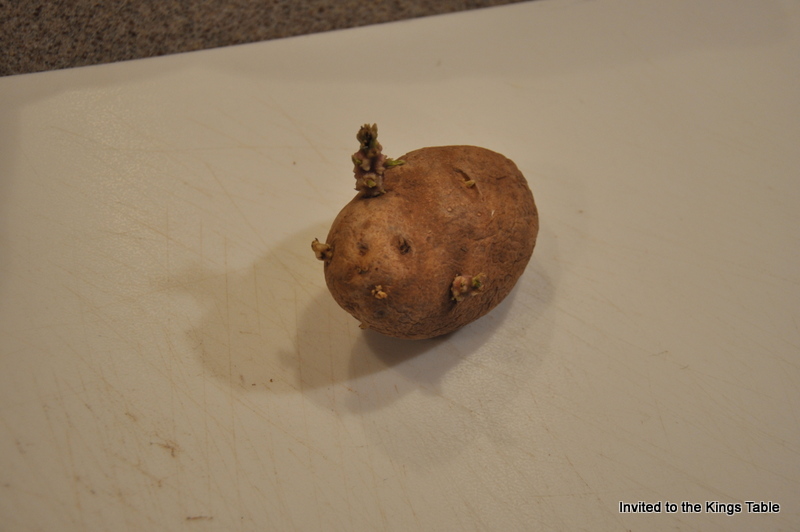
As you can see this potatoes has several sprouts or eye's on it. I can cut in in order to produce several potato plants.  You need to make sure you leave a good portion of potato with the eye because the plant will get some of its feed from the potato seed as it starts to grow.  I use plant whatever has sprouted in the potato bin, whether it is a red, Yukon gold or baking potato.

Here you can see that I have sliced the potato in half so I will have two plants to grow from this one potato. I could slice the one to the right in half again, but I am going to leave it as it is.

You will gently turn the slice up on its side so air can move around it and cure or dry the moist exposed part of the potato.  After a few days you can put the seed into the soil.  you will want to use your shove, hand spade or whatever you have to loosen the soil around the area where it will grow.  There are many different methods to planting a potato. Some use old tires and put the potato in the center of the first one and as the plant grows they add more soil weekly as the plant continues to emerge from the soil they add more and eventually adding more tires etc. I personally have never done this but read about it often.  We dig a little furrow in the soil, drop the seed potato in cover it with about an inch or so of soil and as the plant grows we add more and more soil (and or leaf mixture) around each plant. Within a month or two there will be a nice mound of soil up around each plant.  Once the plant has bloomed and the leaves start to die off a bit you can start to dig your potatoes.  This is usually several months or a bit more after you have planted your potato seed.   Each plant might yield you 6 to 8 potatoes, it depends on the type of potato. 


Once you have dug your potatoes you will want to store them in a nice cool place in order to extend their shelf life. We have a large closet that has shelves from the floor up all the way around the large closet. We stored all of our potatoes in there this past year. You will want to store them on newspaper or freezer paper side by side. Do not stack the potatoes.  They will need to be stored just the way you dig them out of the ground. While you will be tempted to clean them up, don't wash them. Once dug  you can put them on a shaded area so the soil can dry a bit, where the bulk of it will fall off. Do not leave the in the sun and if you dig that morning, be prepared to bring them in to the storage place that evening.  Choose the coolest place you have available to you.  If you have a crawl space under neath your house that you can get to easily, this also works well.  We grew a ton of potatoes last  year, or so it seemed. We dug about 100lbs and used potatoes from our storage room for many months thereafter as well as share some with family and friends.  I hope this has helped spark some interest in grown a few things on the little or big spot of land you have.  No spot is too small, many even use containers when they don't have much ground that is usable.   OK.. I am getting off the soap box.  Y'all have a super week!


shared at Farmgirl Friday Blog Hop

Tuesday, February 7, 2012

*turning the soil

This morning I knew when I woke up, had my quite time and coffee that I would be heading out the door for some time in the warm sun planting onions, more broccoli and kale.  I had contemplated sewing but these things NEEDED to be done, so I went with it.

 All finished...

Before I got started this is how it looked...

We bought onions last fall and planted I don't know how many, but before they were all planted I was tired of onions, so I put the rest of the bulbs in a nice furrow and covered them with dirt. There they lay all in a crowded pile, until today.  The area where they were coming up looked like one of those little cups you put seeds in and it grows hair (grass) of the head - I don't even know what they are called. At any rate, I picked up the clumps of onions  that I refused to plant in the fall and planted them in a nice row with the others.  I have been trimming off the tops of the onions, chopping them and putting them into the freezer. These will come in hand when I am making soups, topping baked potatoes, sauteing veggies etc. They are already growing new tops back at this point.

Eric and I picked up some broccoli and kale plants this past week when we were out together and today they went into the deep dark rich soil where they will grow beautifully!  We have started eating kale like it was spinach, I believe the goodness of one is just about as good as the other. I have found kale easier to grow. The broccoli will be something we eat as it comes mature, however we did purchase it with the rabbits in mind as well. They love leafy greens and the broccoli plants give off a lot of great large green leaves. 


The goats are fed their grain in the mornings in their stall and then let out in the fenced barnyard area to roam around and forage for food.  I caught them napping, or resting while I was working in the garden. I just love this picture. Cleo is laying up against Bodie and Jazzy is laying in the crook of Cleo's legs. So cute! Each time I went near the garden/barnyard gate all of my sweet chickens would come running as if I was going to let them into the garden area.  It doesn't take long for them to learn a pattern, albeit a bit early in the day for such activity.  I will heed their request a bit later in the day, their work in the garden and around the yard beyond the barnyard is much appreciated!


If you have a small patch of land, whether you live in the rural area, suburbs or urban area you can plant some onions at this point. You can usually find a "bunch" of onions at your local feed store, Walmart or Lowe's at this time of the year. Just turn your soil over with a shovel, level it off and make a hole about 1 1/2 inches deep and plant the onion. These will grow with no help from you other than a bit of watering along the way.  Onions will grow nicely in a sunny flower bed and not take away from the beauty of your flower bed either. What about potatoes.. do you have potatoes in your pantry that have "eyes" on them? If so, cut about an inch under where the "eye" is coming out. Simply slice that piece off, leaving a bit of potato under the eye area. You will leave the slice you cut off on the counter or outside somewhere safe for a day or so. The slice will need to "heal" over a bit and then in a day or two you can plant this in an area where the soil is mulched well.  In a few months you will be able to harvest numerous potatoes from that part you would normally cut off and throw away.

Go ahead, I encourage you, if you have even a small spot - plant a seed, or two. Turn those sprouting potatoes into plants that will produce for your family.


shared at Your Gardening Friend
Rural Thursday

Thursday, November 10, 2011

*fall harvest at Erilyn

Henry went inside and got the sickle that we purchased at an antique shop a long time ago. We were simply breaking the ears off our our corn stalks. Well, we are never SIMPLY doing anything around here. The sickle made the job so much more enjoyable.
We did not get corn planted in the spring, but decided to give late fall sweet corn a try.  We did pretty good. A lot of the cobs were still immature, but not a waste at all. 

It wasn't a waste because both the goats and the chickens were grateful! 

Today when we came in from the garden we brought 4 large broccoli heads, tons of late sweet corn, more banana and hot peppers than I know what to do with as well as a basket of winter squash. 

Tonight for dinner we enjoyed some creamed corn straight from the garden.  My mother makes some of T. H. E. best  creamed corn you will ever eat - this came no where near as good as hers, but it was still good.  We will be able to have several meals from the corn crop from this fall.   I finally got all of those onions planted as well.

If you remember earlier this week I was sharing with you about a quilt that I have been working on.   I had hoped to get the top completed by Wednesday, but is still sitting where I left it.  I have had some migraine headaches lately which pretty much put me in a state of doing nothing but resting in a quite, cool dark room.    I am feeling much better now and I will be sewing this weekend!

Thursday, October 20, 2011

*becoming self sufficient (food wise)


We have chosen this life of being more self sufficient. Less dependent on the normal American food supply that a large majority of our country rely on for putting food on their tables.  We started stepping out of the box a number of years ago by reducing the amount of "table salt" and kind of salt that we use, the amounts of refined sugar we use and changing that to other natural sweeteners such as sucanat, honey and agave nectar along with the introduction of grinding our own wheat for flour needs.   Now, just like anything, we have gone through our "rid the house of ALL the white stuff" and then back to a happy medium for our family.  Growing your own meat, vegetables and fruit insures that you know what is going into it, how it is prepared, what it is NOT being preserved with before it hits your table.

We are now choosing to grow as much of our own produce in season as possible.  We planted a huge garden in the spring and this fall we have a good sized garden as well. This past week we dug, well Momma dug about a bushel of sweet potatoes.  Delicious sweet potatoes that I didn't think existed. Surprise!

Growing nicely in the perennial patch of our vegetable garden you will find asparagus, tons of beautiful strawberry plants, basil, thyme, and a few other herbs. 

Summer squash are not just for the summer! 

 These are our beautiful asparagus  plants flourishing nicely! (see the corn in the background?)


In our garden this fall you will find summer squash, pink eye peas, butternut squash, acorn squash, spaghetti squash, cucumbers, corn, broccoli, red cabbage, brussel sprouts, kale, a few tomatoes, traditional cabbage, and this week I plant sweet onions, red onions and garlic!   


Sometime in the next month we will have to purchase potatoes for the first time since April, and we are a big potato eating family.  (fried potato slices, fried potato wedges, mashed potatoes, potatoes for numerous soups, baked potatoes.... yadda yadda)  And just this week we purchased onions for the first time since late spring as well.

Years of leaves have laid on the ground here at what is now known as Erilyn.  I was really thrilled to find this the case, once I got past the reality that they do not magically get raked up and that a ton of effort has to be put forth to get them up, I was thrilled.  My mother truly has been instrumental in getting the majority of leaves raked up. Once we got the broken down, decayed leaves up, we headed straight to the gardens!  The decayed leaves add such richness to the soil in the garden and do magic at keeping down the weed and grass growth.

I encourage you to consider a plot in your yard for some vegetables this coming spring!  What about the flower bed on your property? One potato plant can yield you enough potatoes to make mashed potatoes for a family of 6 to 8.  Get creative, use the space you have!

Wednesday, August 3, 2011

*the fiber of our lives


Cotton.

160 days frost free needed for growth.

I am not a cotton farmer, I do not know anything at all really about this important crop or how to properly grow it.  What I do know is my dear friend, Jen, gave me some seeds to plant for fun and plant we did.  We have watched these beautiful deep green plants grown and bloom for months now.  The bolls on the plants have been waiting for the right moment to show the beauty that lies within!  Just this past week the bolls started opening to show forth the beautiful white cotton.

Are you raising young children? Are you home educating your children? Or are you just curious like I was about the cotton plants stages of growth? Either way, I have numerous seeds that I would like to share with some of you.  If you are interested in a few seeds please leave me a comment below and I will get in contact with you.  Here is a great link for educators about the cotton crop.

I am going to allow the cotton to dry out nicely and use it as part of our decor somewhere in our home. I will use some of the nicely opened bolls to make some cotton angels and other crafts.

This is the last crop in our summer garden spot. This week the area will be tilled for the fall crops!  We will be planting broccoli, cabbage, beets, onions, late corn, some more tomatoes, and more. Are you planting a fall garden? If so, what are you planning to plant?


Tuesday, June 14, 2011

*growing tomatoes


As a young girl I watched, took notes and participated in a large garden each year. On some days I was thrilled to be out helping momma and daddy, others.. not so much.  I have learned much of what I know about gardening through my parents.  I love the example they have set for me in this.

I wanted to share with you how we get such beautiful tomatoe plants each passing year.   Surely, many of you have monster tomatoe plants as well and do not do the same things as we do, so I am not saying we have the secret answer to a prosperous bush.  Lets get started:  First we take the first few small leaves off of the base of the little tomatoe plant and plant it about 2 inches or so deep.  As the bush starts to grow we watch closely and pinch out the suckers in order to give the plant more energy where needed.


We have never pinched the tops of our plants out, though I am sure some do and yield a large amount of fruit.  This is just how we do it.  We start with a 10-10-10 fertilizer about three weeks after the plants are set it and fertilize weekly there after. My father, lives and breathes by Miracle Grow, but we have stuck with a 10-10-10 for now.  For such a large garden as ours, the 10-10-10 is much cheaper and it seems to be working. We also add the tomatoe cages when the plant is still young.  Because the plants get so large and heavy with the fruit we also drive a stake down inside the cage for extra protection. 


These are our cucumber plants to the left and  our tomatoe bushes to the right.  When planting these two crops, ample room was left between rows - the cukes have just taken over and under and OVER!


This is the outside of the left side of the cucumber row.  Simply amazing.


When momma came this last time she brought with her a canning book, which has come in quite handy.  We used the recipe out of this book to make our pickled dills and now I am using it to make salsa.  I canned 5 pints of salsa yesterday, 2 half pints of orange marmalade, and 11 more jars of pickled cukes!  Our pantry is filling up!